Adjusting Ranges in Multi-Table Tournaments: Position, Blinds, and Dynamics
Written by Lars Frank · Aug 25, 2026

Adjusting Ranges in Multi-Table Tournaments: Position, Blinds, and Dynamics
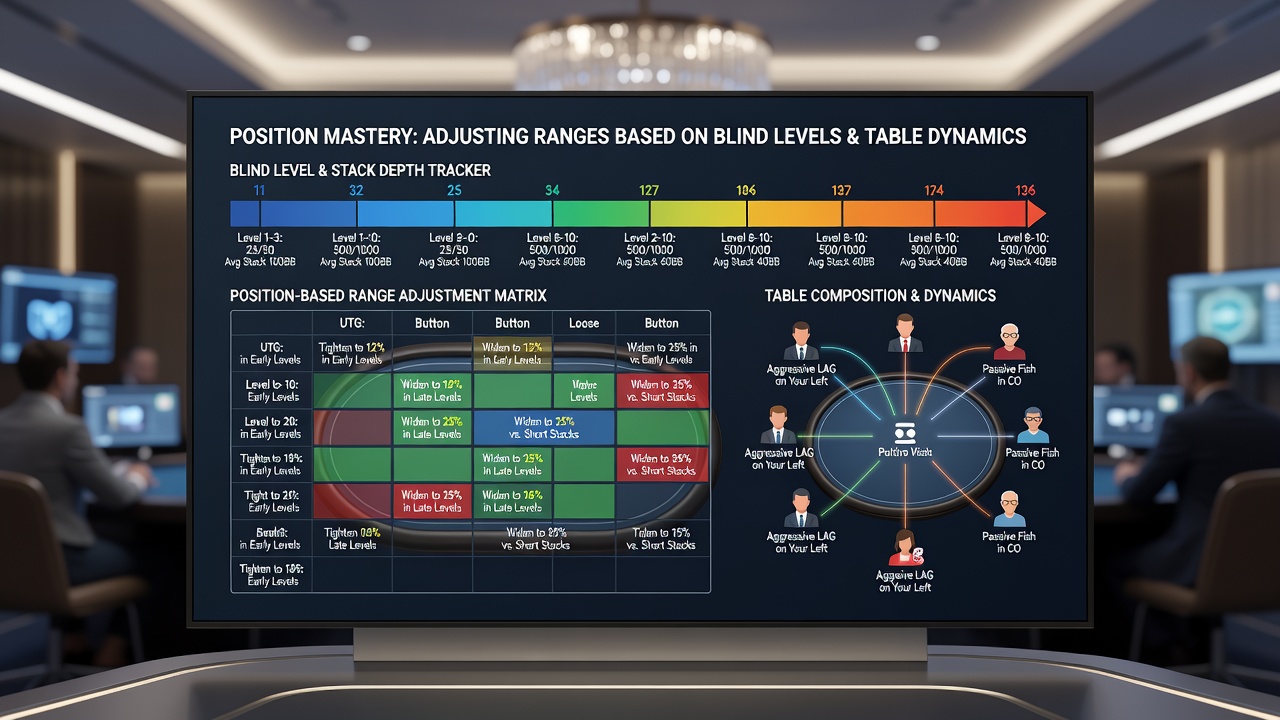
Position mastery forms a core element of success in multi-table poker tournaments where players must adjust their ranges continuously as blind levels rise and table dynamics shift, and researchers have documented how early-stage play rewards tight-aggressive selections from early positions while later stages demand wider defenses from the blinds. Observers note that data from major events shows players who tighten their opening ranges by 15-20 percent in early positions during the first few levels maintain deeper stacks on average than those who play loose, and this pattern holds because antes and blinds remain small enough that speculative hands lose value without strong positional advantage.
Early Blind Levels and Positional Range Construction
During the opening stages of a tournament the effective stack-to-blind ratio stays high, which allows players to select hands that perform well postflop when they hold position, and experts have observed that button and cutoff ranges can expand to include suited connectors and small pairs while under-the-gun selections stay limited to premium holdings such as big pairs and strong aces. Studies indicate that table dynamics play a decisive role here, since a table filled with loose callers forces even late-position players to tighten slightly to avoid multiway pots with marginal equity, whereas a tight table permits wider stealing attempts from the cutoff and button because fold equity remains elevated.
Mid-Stage Adjustments as Blinds Increase
As blinds climb and antes enter the pot the pressure on short stacks intensifies, prompting range adjustments that balance survival with accumulation, and data shows that players in late position can profitably widen their three-bet ranges against early-position opens because the increased dead money improves pot odds. Those who have tracked thousands of hands note that table image becomes critical during these levels, since an aggressive table dynamic rewards tighter calling ranges from the big blind while a passive table allows more frequent float plays from position when continuation bets appear frequent yet weak. Effective stack sizes also influence decisions because shorter stacks behind force earlier positions to reduce their opening ranges to avoid difficult postflop spots out of position.
Late-Stage Dynamics and ICM Considerations
In the later stages independent chip model pressure alters range construction dramatically, and players holding position gain additional leverage because they can apply pressure on multiple streets without committing their entire stack, whereas out-of-position ranges must shrink to protect equity. Research from tournament databases reveals that button shoving ranges expand significantly once average stacks fall below 20 big blinds, yet early-position shoves remain narrow because the risk of running into premium holdings increases when multiple players still act behind. Table dynamics shift further when pay jumps approach, since players tighten overall yet still defend wider from the blinds when they hold position on the initial raiser and can realize equity more effectively.
Practical Range Examples Across Positions
Take one common scenario where blinds sit at 400-800 with a 100 ante and a 25-big-blind average stack, and experts recommend that the hijack opens approximately 22 percent of hands while the button opens 45 percent, adjusting those figures downward when the table shows frequent three-bets or upward when opponents fold to steals more than 70 percent of the time. Another case occurs when a tight early-position player raises and action folds to the cutoff, where position allows a wider calling or three-betting range because the player acts last on every postflop street and can control pot size more precisely. Observers note that these adjustments rely on accurate reads of opponent tendencies rather than fixed formulas, since a single loose player in the blinds can justify tightening late-position opens to avoid difficult out-of-position confrontations.
According to findings published by the University of Alberta poker research group, positional advantage compounds across multiple orbits when players maintain consistent range discipline, and the same study highlights how blind-level progression forces incremental widening of late-position ranges to maintain stack growth. Data collected from European Poker Tour events further supports the value of dynamic adjustments because participants who adapted their ranges to shifting table aggression posted higher average finishes than those who maintained static strategies.
Conclusion
Position mastery in multi-table tournaments ultimately rests on continuous observation of blind levels and table dynamics, and those who integrate these factors into their range decisions create consistent edges that compound over the course of an event. Players who track how their ranges interact with stack depths and opponent tendencies across each stage of the tournament position themselves for deeper runs and larger payouts.